

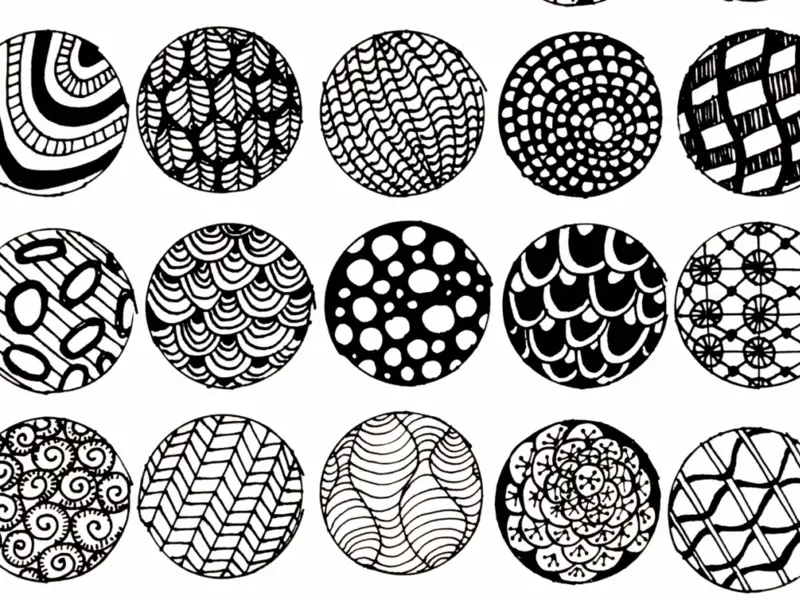
Zentangle® is a drawing method created by Rick Roberts and Maria Thomas. You build a drawing out of simple repeating patterns, one pen stroke at a time, so no drawing skill is needed. The official Zentangle site has the full story, and the trademark belongs to them.
This page gives you free printable pattern sheets, practice pages, a step-by-step first tile, and links to starter pages, books and classes. Beginners can start with the first tile below. Experienced tanglers can jump to the inspiration gallery.
Zentangle vs. Doodling
Doodling is loose: any scribble that fills a space. Zentangle follows a method with a small set of materials and a set order of steps, and it builds drawings from structured patterns called tangles. Roberts and Thomas took something many people do naturally and added intention, which is much of why it appeals to people who think they can’t draw.
Supplies for Zentangle
The official method uses a 3.5-inch square paper tile, a black Pigma Micron 01 pen, and a soft pencil for the guide marks and shading (Zentangle Classic Kit). You can also tangle on any heavy white paper or cardstock. Here are some supplies to start with:
Sakura Pigma Micron Pen Set, Black 6CT Set Studio Series Artist’s Tiles: White (75 pack)Sakura Zentangle Tool Set, 12 PieceUni-Ball Signo Broad Point Gel Pen – White – Pack of 3Strathmore Artist Tiles, Black, 6×6Blackwing 602 Pencils


Sharpies work, but they bleed through thin paper, so use cardstock or a tile and keep a scrap sheet underneath.
Easy Zentangle Patterns for Beginners
Simple patterns are the best place to start: they are quick, relaxing, and look good once you repeat them. You can also draw the same base pattern several times and change it by shading different areas. The printable pattern below shows how.
First up is a free PDF of tangle patterns. I made it before I really knew what Zentangle was, so it is a beginner sheet. Click the image to download.

These are patterns I liked when I saw them, and many appear in this easy Zentangle project. Here are two more pattern sheets to download (click the images):


Print them and keep them where you draw, or build a binder of patterns. Some look harder than they are: most are made of straight lines, curves, circles and dots drawn in a repeating order.
A great way to learn patterns is to make a sampler page. Fill in a gridded page, or pencil in circles to tangle inside, using a stencil. I made blank practice pages of the squares and circles in pattern groups 2 and 3 above, and you can download the blank pages here.
How to Draw Your First Zentangle Tile
Ages 8 and up on their own, younger with an adult nearby. Difficulty: easy. Time: about 15 to 30 minutes. You need one tile or a 3.5-inch square of cardstock, a pencil, and a fine black pen.
- Make a dot in each corner of the tile with the pencil.
- Connect the dots with light pencil lines to draw a border.
- Draw a loose pencil line, called a string, that wanders across the tile and splits it into sections.
- Fill each section with a different repeating pattern in pen, such as stripes, rows of scallops, overlapping circles, or a crosshatch grid.
- Shade with the pencil along the edges of a pattern, and blend with a finger or a tortillon so shapes look rounded.
- Sign or initial your tile, then step back and look at it.
The official method has eight steps, which begin with a moment of gratitude and end with appreciating the finished tile.
Tips for Starting Out
- Mistakes happen, sometimes on the last line. You can scan the drawing, edit out the stray line, and print it again, or work the wonky line into the design.
- Try different pens. I used Sharpies for a long time, and when I want fancier pens I choose Faber-Castell Pitt pens or Microns. Use what you like.
- When you start to go cross-eyed, take a short break: rest your eyes, look at something far away, and stretch your fingers.
- Tangling is forgiving. A pattern you don’t love usually blends into the finished piece, because the other patterns balance it out.
Example: In this Zentangle hand-drawing I made as part of these 3 hand drawing ideas, I disliked one pattern, but the finished drawing still looks good.
Next Level Zentangle Patterns
These examples come from people who have been tangling for a while. Use them as inspiration, and click through to see more of their work. To learn more intricate patterns, look for classes with a Certified Zentangle Teacher, YouTube, books and other websites.
View this post on Instagram
View this post on Instagram
View this post on Instagram
View this post on Instagram
View this post on Instagram
View this post on Instagram
View this post on Instagram
View this post on Instagram
View this post on Instagram
View this post on Instagram
View this post on Instagram
View this post on Instagram
Printable Pattern
Download this PDF, print it, and try shading different areas to make the pattern look different. I made a whole book of easy patterns to draw, too: Draw Your Own Damn Coloring Book.

More Zentangle Pattern Resources
Zentangle Starter Pages
My first pack of tangle starter pages sold well enough that I made a second pack, and you can buy all 12 together at a discount. They give you pre-made designs to practice your patterns in. Find them here.

Zentangle Pattern Videos
Zentangle Books
One Zentangle A Day is a good first pick if you like a guided course. I also included my book in the group: it is half tangling for kids, half drawing games.
One Zentangle A Day: A 6-Week CourseThe Great Zentangle Book: Learn to Tangle with 101 Favorite PatternsJoy of ZentangleZentangle for KidsTangle Art and Drawing Games for KidsZentangle Basics, Expanded Workbook EditionZentangle Art TherapyZentanglePattern Play: a Zentangle Creativity Boost (Volume 1)Zentangle(R) Dingbatz
Zentangle Classes
- Zentangle 101: Learn to Tangle
- Zentangle 102: Basics and Beyond!
- Zentangle® 103: Creating Dimension with Layered Tangles
- Zentangle® 104 – Shading Zentangle

Find Tangle Starter Pages Here:
Original Tangle Starter PagesTangle Starter Pages Round 2Save Money With the Entire Dozen
Here is my finished tangle, which I made extra colorful:

More Zentangle Ideas
- Print the same design for everyone and compare how different the finished pages look.
- Limit yourself to black only, or to two or three colors.
- Tangle with a friend: each of you starts a page, then you swap after about 30 minutes.
- Print starter pages on heavy white cardstock. Fill some white spaces with watercolor or marker, let it dry fully, then tangle over it.
- Add glitter: dab glue (adult-supervised for young kids) onto a few shapes, sprinkle on glitter, and shake off the extra. Keep glitter away from small children who still put things in their mouths.
- To protect a finished piece, brush on a coat of Mod Podge (follow the label, work in a ventilated space, and let it dry between coats).
- Kid craft: cut out tangled circles and seal both sides with several coats of Mod Podge, letting each coat dry, to make decorative coasters. They are for display or cold drinks, not for hot mugs, and an adult should handle the sealer.
- Another Zentangle project: a very easy way to get kids tangling.
Even More Zentangle Ideas
- Zentangle animals: lots of beautiful inspiration.
- More Zentangle pattern inspiration is here.
- Make a tangle bullseye, which is a bit like a mandala.
- Just for kids: a watercolor tangle rainbow.
- My book, Draw Your Own Damn Coloring Book, has easy directions for drawing coloring pages or tangle starters.

Comments
0 comments
It’s brilliant!
Aw, thanks Jacky! I hope you have fun with it.
When I draw with my kids my favorite thing to do is take a ruler and draw intersecting lines all over the paper and then color them in. I didn’t know I was ZENTANGLEing!!! Can’t wait to get your pages and start coloring!
Ha! You just discovered it on your own. 🙂 Have fun with the pages!!
The starter pages are new. The method has been around for years (www.zentangle.com) as well as the patterns (www.tanglepatterns.com).
How do we access the starter pages? I can download the designs, but not the starter pages. Thanks!
My 2nd grade students love doing pentangles.
Hi Stacy! You can access them here: https://craftwhack.com/store/ I changed the image so it links right to my store now- I guess that would help 🙂 I’m so excited you’ve done this sort of thing with your second graders. I’d love to witness a whole class full of kids absorbed in doing this. 🙂
Thank you! You rock! I try all sorts of things with my students each year. This year there is a heavy emphasis on mindfulness at my school. Taking care of the self is very important and I wanted to show the kids that drawing can be very soothing for the mind, body and spirit. I needed to tap into “all” of their interests so I could hook them into the world of mindfulness with different choices. Zentangles continue to be a HUGE hit!
You sound like an awesome teacher!
its funny, isn’t it…most of us have done something like this before. Now it has a real name. But it’s still lots of fun seeing how everyone else does it, and learning from everyone else.
Fun project with the grandkids. What size paper do you use for the pattern pages?
I just use 8 1/2 x 11″ for them-I hope you have fun!
Hi Nora! I hope you are enjoying it- so glad to be of help!
Hello,
I love it, my daughter loves it. And since I am doing recess buddies with Gr 1 and 2, can I print copies to work with them? Thank you! God bless you for your amazing ideas!.
May
Of course! Thanks for asking- enjoy!
awesome stuff, this is and pinterest are my favorite websites
yay
All these patterns are so elegant and amazing, whimsy and playful, angry and spicy, boring and plain (in its own good way)!!!!!!
Why thank you, Dania! What an amazing description!
Hi Christine- I updated the links so they should work now- but here is the new link anyway- thanks! https://craftwhack.com/shop/
I love it . thank you for photos
and I am Iranian . your website is very good. thanks for your photos
Hi Dawn! Thanks so much for your comment- I’m thrilled to hear that you like my website. It’s always so fun to hear from people!
Hello from Singapore!! I was at Artful Parent page trying out the Zentangle-inspired activity with my 5-year-old girl. It then led to your website for beginners tangling. Thanks for sharing.
And i LOVE iced green tea too!!!
Raudha
Singapore
Hi Raudha! I’m so glad you made your way over here. Did your daughter like the tangle project? I’m finding that some younger kids like to do it, and some find it totally boring (like my son) 🙂 Thanks for the comment, and let’s have a virtual green tea together…